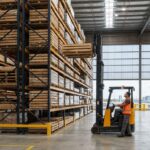
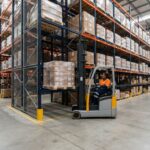
For Melbourne warehouse operators considering selective pallet racking melbourne, the key question is whether direct access to individual pallet positions suits the stock profile and daily workflow enough to justify the aisle space required.
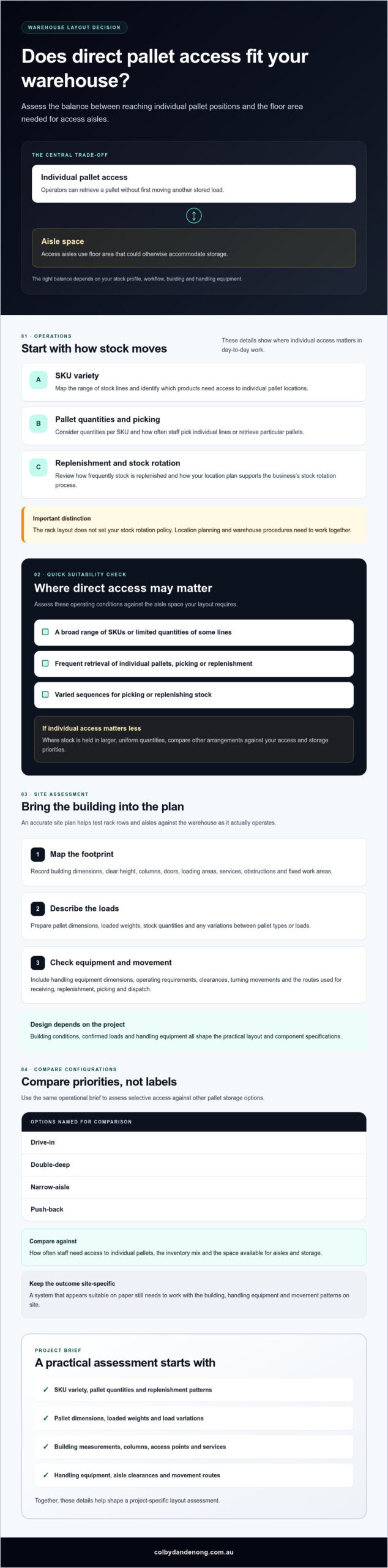
Assess the trade-off against actual operations. A varied SKU range, frequent picking or regular replenishment may make individual access important. Building dimensions, column positions and forklift clearances also shape the layout. A system that looks suitable on paper still needs to work with the handling equipment and movement patterns on site.
This article explains how to assess whether selective racking fits your warehouse, compare storage options against inventory and workflow needs, and prepare a clear brief for a project-specific design. It covers the operational details to review, site information that helps shape a practical layout, and questions to resolve before commissioning a system in Melbourne or elsewhere in Victoria.
Key Takeaways
- Map SKU variety, pallet quantities and replenishment frequency to clarify how often staff need access to individual pallet locations.
- Check how rack rows, aisles and picking routes will work with your handling equipment and warehouse footprint.
- Compare selective racking with drive-in, double-deep, narrow-aisle and push-back systems against your access and density priorities.
- For selective pallet racking Melbourne projects, prepare site measurements, pallet and load details, handling equipment information, and the location of columns, access points and services.
- Use your operational brief to guide a project-specific design, supply and installation assessment with Colby Dandenong.
When selective racking suits a Melbourne warehouse
Selective racking stores pallets in individual positions that operators access directly from an aisle. A forklift can retrieve a pallet without first moving another stored load. This suits operations where access to specific stock locations matters. The trade-off is that each access aisle uses floor area that could otherwise accommodate storage. The decision comes down to balancing location access with space for rack rows, aisles and vehicle movement.
Start with the work the system needs to support. Consider SKU variety, how often staff pick individual lines, pallet quantities per SKU and how stock is replenished. These details show whether direct access is valuable across much of the inventory or only for selected products. An overview of selective pallet racking systems also explains the individual-access principle behind this configuration.
Direct access and everyday warehouse operations
Because each pallet location faces an aisle, operators can reach a required load without relocating a neighbouring pallet first. This can suit mixed-SKU stock, frequent order picking and replenishment that requires access to particular loads. It can also work with a business’s existing stock rotation process, provided locations and inventory records are managed accordingly.
The rack layout does not set the stock rotation policy. Whether the business uses first-in, first-out, another method or different rules for different goods depends on its operational requirements. The location plan and warehouse procedures need to work together.
Warehouse conditions that favour accessible pallet positions
Direct access is worth assessing if a warehouse holds a broad range of SKUs, keeps limited quantities of some lines, or regularly retrieves individual pallets. It may also suit operations where stock is picked or replenished in varied sequences. These are decision factors, not a guarantee of faster handling or greater storage capacity. If most stock is stored in larger, uniform quantities and individual pallet access is less important, compare other arrangements too.
Site and load details determine whether a proposed layout is practical. Confirm pallet dimensions, loaded weights and variations between loads. The design also needs to account for the building’s clear height, floor and structural conditions, columns, access points and other obstructions. Handling equipment matters as well: its dimensions, operating requirements and turning movements affect aisle planning and access.
A search for “selective pallet racking melbourne” can help identify the topic, but choosing a system requires a site-specific assessment. Bring the operational and facility details together to test whether direct pallet access fits the warehouse footprint and handling method, or whether the space trade-off points towards a different configuration.
How selective racking shapes warehouse layout and workflow
A selective layout is more than a set of rack rows. Each aisle affects which pallet positions operators can reach, how they travel between locations and how much floor area remains for other warehouse activity. Plan for storage access as well as the routes used for receiving, replenishment, picking and dispatch.
Pick and reserve storage zoning helps separate stock needed for daily order picking from bulk reserve stock. Inventory patterns help determine where access matters most. A high SKU count with relatively small quantities per line may call for frequent access to individual locations. Fewer SKUs stored in larger quantities may create different priorities. Replenishment frequency also matters: locations restocked often need to fit the movement of stock and vehicles through the warehouse. Direct access can support varied picking requirements, but the aisles it needs affect how much floor area is available for pallet positions.
Site and inventory information for a layout assessment
Start with an accurate site plan. Record building dimensions, clear height, columns, doors, loading areas, services and other obstructions. Include fixed work areas that affect where rack rows can sit. These details help the project team test possible row arrangements against the building rather than an idealised floor plan.
Prepare pallet dimensions, loaded weights, stock quantities and expected movement patterns. Note variations between pallet types and any anticipated changes to the inventory mix. This information informs the design, but it does not establish a universal configuration. Final beam levels and component specifications depend on project-specific design and confirmed loads.
Aisles, forklifts and warehouse material flow
Aisle placement affects access routes and the floor area available for storage. The project team should assess the forklift type, its operating requirements and the clearances needed to approach and retrieve pallets safely. Consider turning movements, end-of-aisle access and interactions with pedestrian or other vehicle routes. Do not select aisle dimensions separately from the equipment and work practices on site.
For a Victorian facility, review WorkSafe Victoria’s guidance on pallet racking operation and maintenance as part of planning and ongoing management. Confirm which requirements apply to the project with the relevant design team.
Review Colby Dandenong’s pallet racking systems alongside your site and inventory information. A project-specific assessment can then consider how the proposed layout fits the warehouse’s workflow and handling equipment.
Compare selective access with denser pallet storage options
Before settling on a layout, check how access requirements vary across the inventory. A warehouse may need frequent access to some product lines, while other stock is handled in predictable batches. Mapping those differences can help the project team identify where direct access matters and where another storage arrangement may be worth assessing. One configuration does not have to suit every item.
| Planning factor | What to review | Why it matters |
|---|---|---|
| SKU profile | Range of product lines and how many pallet locations each line needs | Shows whether access needs vary across the inventory. |
| Picking pattern | Which lines are picked individually and how often | Helps identify locations where direct access is operationally important. |
| Replenishment | How stock is replenished and whether replenishment overlaps with picking | Informs location planning and movement through the warehouse. |
| Stock rotation | Rules used for different products and how locations are managed | Checks that the proposed arrangement supports the operation’s procedures. |
| Handling method | Equipment used and the way loads are placed and retrieved | Helps confirm that the layout can support intended movements. |
When individual pallet access is the priority
Use picking records and replenishment routines to identify products that need frequent, independent access. For example, if order lines regularly draw from many different SKUs, note which pallet locations need to remain directly reachable and how staff approach them. This gives the design team a clearer basis for assigning locations and planning picking routes. It does not mean every product has the same access requirement.
When to assess a higher-density alternative
If some inventory is stored and handled in consistent batches, record that separately from stock needing frequent individual access. Share the quantities, rotation rules and retrieval sequence with the project team. They can assess whether those operating conditions justify considering a denser arrangement for that stock, such as drive in racking in Melbourne. Handling equipment, building constraints and the effect on day-to-day workflow still need review before selecting a configuration.
Keep the assessment tied to actual stock and work practices. A clear picture of which items need individual access, and which follow different handling patterns, helps the design team define the questions to resolve for each part of the warehouse.
Assess a selective racking project for a Victorian site
A useful project brief connects warehouse operations to the physical site. Document how stock is received, stored, picked and replenished, then check whether the building and handling equipment can support the layout being considered. For a Melbourne warehouse, an accurate site plan and realistic inventory information help the design team assess the arrangement before deciding on rack positions and components.
Information to prepare before the design stage
Work through the assessment in sequence. First, document current workflows and planned changes, such as a shift in SKU mix or picking methods. Next, prepare a dimensioned warehouse plan. Include clear heights, columns, doors and other access points, services, fixed work areas and physical obstructions. Mark areas used for receiving, dispatch and vehicle movement so proposed rack rows can be assessed in context.
Then compile the stock and handling details:
- Pallet dimensions and loaded weights, including variations in the loads stored.
- SKU quantities, replenishment patterns and expected stock movement.
- The handling equipment in use, its operating requirements and the workflows it supports.
These inputs inform the design, but they do not establish beam levels or component specifications on their own. Those decisions require project-specific assessment of confirmed loads, building conditions, layout and handling method. If a search for “selective pallet racking melbourne” has prompted the project, use it as a starting point for gathering site information, not as a substitute for design advice.
Victorian safety and standards considerations
Ask the design team to confirm the current relevance and scope of AS 4084-2023 for the proposed racking, and check which WorkSafe Victoria guidance applies to the facility and installation scope. Relevant considerations can depend on the specific project, so avoid relying on generic capacity statements or broad claims that a layout is compliant without supporting project information.
Request design details that relate to your actual pallet loads, warehouse conditions and operating equipment. Keep the site plan and inventory brief available for review, and raise uncertainties before the configuration is finalised. This gives the project team a clearer basis for assessing access, layout and the requirements that apply to the installation.
To discuss a site-specific racking assessment, share your warehouse and inventory details with Colby Dandenong.
Scope your Melbourne racking project with Colby Dandenong
The right system depends on more than a preference for direct pallet access. Your inventory profile, handling requirements, warehouse layout and available floor area all shape whether selective racking is suitable. Project scope also depends on facility dimensions, engineering specifications and confirmed load requirements. A generic layout or capacity claim is not a substitute for a site-specific assessment.
What to include in a project enquiry
A clear brief helps the project team understand both the warehouse and the work it needs to support. Include the site location and, where available, a warehouse plan showing clear heights, columns, access points, services and other known constraints.
Also share the operating details that affect storage and handling:
- Pallet dimensions and loaded weights, including any variations.
- Stock profile, such as SKU range, pallet quantities and expected movement.
- Handling equipment and the way goods are received, replenished, picked and dispatched.
- Project timing, and whether the facility is new, operating during the project or being reconfigured.
Flag planned operational changes too. A change to the stock mix, handling equipment or workflow may affect the design brief, even if the building itself remains the same.
From operational review to project scope
The next step is to review site and operating requirements, then develop a project-specific design rather than apply a standard specification. Colby Dandenong provides project-based design, supply and installation for warehouse storage systems. The proposed arrangement and components need to reflect the actual facility, loads and handling method.
Bring your warehouse plan and operating information together before requesting a tailored quote. Colby Dandenong can use those details to discuss the project scope and the information needed for the next stage.
Contact Colby Dandenong to discuss your racking project and request a tailored quote.
Plan direct pallet access around your operation
The right layout balances access to individual pallet positions with the floor area required for aisles. SKU variety, picking and replenishment patterns, pallet loads, building constraints and handling equipment all influence whether selective racking fits your warehouse or a denser option deserves consideration.
For a Melbourne project, a search for “selective pallet racking melbourne” is only a starting point. A useful assessment needs a site plan and clear information about inventory and daily operations. Colby Dandenong supplies selective racking and provides project-based design, supply and installation services for businesses across Melbourne and Victoria.
Bring your facility and handling details together to help define a practical project scope. Contact Colby Dandenong about your warehouse project to discuss the next step and request a tailored quote. With clear project information, you can move towards a layout that reflects how your warehouse operates.
Frequently Asked Questions
What is selective pallet racking?
Selective pallet racking stores pallets in individual positions that operators access from an aisle. An operator can retrieve a chosen pallet without first moving another stored pallet. This provides direct access to each location, while the aisles required for access use floor area. Assess the arrangement against the warehouse’s inventory, picking patterns, replenishment activity and handling equipment.
What are the main advantages of selective racking?
Its main advantage is direct access to individual pallet locations. This can suit warehouses with varied SKUs, frequent picking or regular access to specific loads. It also allows the operation to manage stock rotation through its own procedures, though the rack layout does not set that policy. The trade-off is aisle space, so selective racking will not suit every inventory profile or building layout.
How does selective racking compare with double-deep racking?
Selective racking provides access to each pallet from an aisle, while double-deep racking stores pallets two positions deep. Reaching a rear pallet may require moving the pallet in front, and the handling equipment must suit the configuration. Compare SKU quantities, access frequency, stock rotation and equipment requirements. The right balance of access and density depends on the site and workflow.
Can selective racking be installed in an existing Melbourne warehouse?
It can be considered for an existing warehouse, subject to a project-specific assessment. The design team needs to review building dimensions, clear heights, columns, doors, services and other obstructions, along with intended loads and handling equipment. If your search is “selective pallet racking melbourne”, treat it as a starting point for assessment. The warehouse layout and operational requirements should guide the design, not floor area alone.
What information is needed to plan selective racking?
Prepare a dimensioned warehouse plan showing clear heights, access points, columns, services and obstructions. Include pallet dimensions, loaded weights, SKU quantities, stock movement and replenishment patterns. Identify the handling equipment and describe how goods are received, picked and dispatched. Note whether the warehouse is new, operating or being reconfigured, and flag planned changes. These details help inform a project-specific design and scope.
Which Australian Standard should be considered for steel storage racking?
AS 4084:2023 is the Australian Standard to consider for steel storage racking. Ask the project team to confirm its current relevance and scope for the proposed system and site. In Victoria, also check which WorkSafe Victoria guidance applies to the facility and installation. Requirements depend on the project circumstances, so seek advice from relevant design professionals instead of relying on generic compliance or capacity claims.
Can selective racking be combined with other warehouse storage systems?
Yes. A warehouse plan can assess selective racking alongside other systems where different stock or workflows need different arrangements. For example, pallet racking may serve palletised inventory while shelving or conveyors support other handling needs. The project team should review how the systems fit the building, stock movement and equipment routes. Any combined layout needs project-specific design rather than an assumption that separate systems will work together unchanged.