Forklift Compatible Racking: How Truck, Load and Layout Fit Together
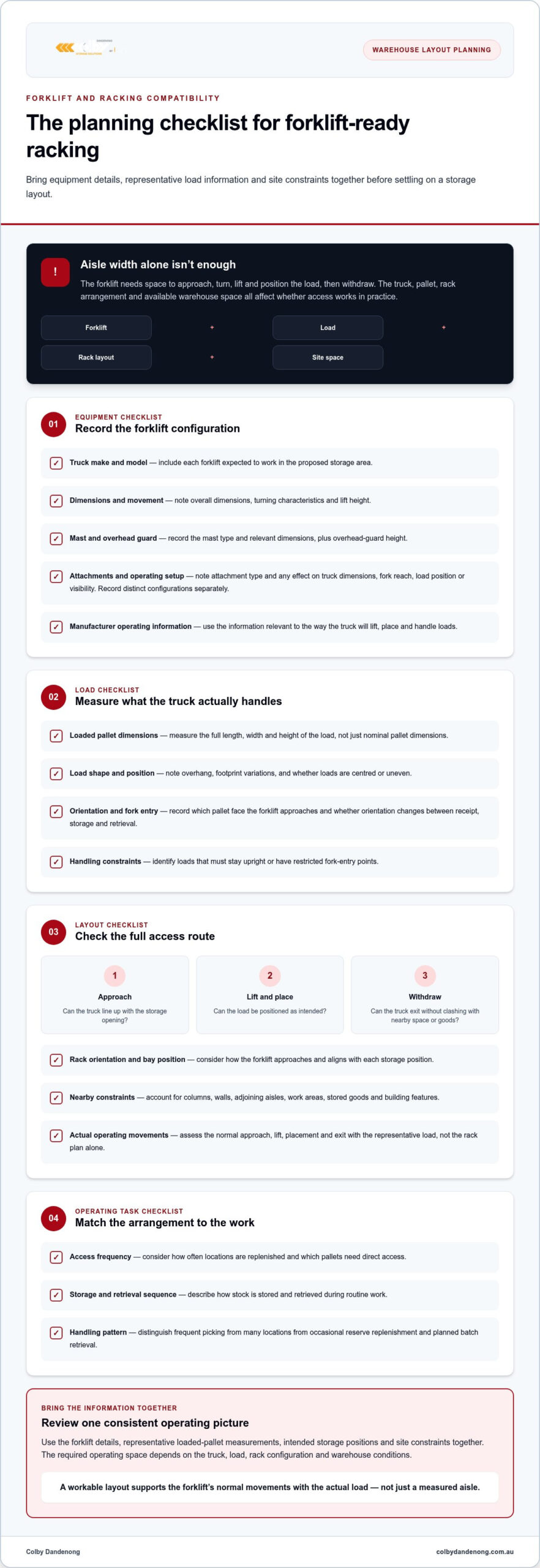
Racking has to suit the truck that serves it, the loads it carries and the space around it. An aisle measurement on its own can’t show whether a forklift can approach, turn, line up and place a pallet safely and consistently.
WorkSafe Victoria’s safety guidance says racking layout should suit the forklifts used, including matching the aisle to the forklift’s turning circle. This article explains how truck type, load profile and attachments affect access, and what to recheck when your equipment changes.
Why a single aisle dimension isn’t enough
Compatibility is the fit between the forklift, the load, the rack arrangement and the space for its normal movements. A pallet may physically reach a storage position without the truck being able to place and retrieve it safely every day.
The truck has to approach the bay, align with the opening, lift, position the load and withdraw without hitting nearby racking, stored goods, building features or other traffic. Published aisle figures and rules of thumb can start a discussion, but they aren’t design instructions. The space you need depends on the truck and its task, the load, the rack configuration and the site.
How truck type changes the requirement
Truck categories describe operating patterns, not fixed dimensions.
| Truck type | How it works | What to consider |
|---|---|---|
| Counterbalance | Carries the load ahead of the front wheels | Turning, alignment, load placement and withdrawal |
| Reach | Extends its load-handling mechanism towards the rack | The truck’s operating configuration and reach relative to the rack opening |
| Narrow-aisle | Works within a layout designed around its operating method | The truck’s method, guidance, aisle, rack access and floor conditions |
Don’t select an aisle dimension from the truck category alone. The model, load, attachments and rack arrangement all matter. For specialist trucks, the layout is designed around the equipment, as covered in our guide to narrow aisle racking requirements and our narrow aisle pallet racking systems.
The load matters as much as the truck
Measure the loaded pallet, not the nominal pallet size. Record:
- Full length, width and height, including any overhang
- Whether the footprint varies between product lines
- Whether loads are centred or uneven
- Handling constraints, such as loads that must stay upright, and which pallet face the truck approaches
A load that projects past one edge can affect entry into a rack opening even when the pallet itself fits. WorkSafe Victoria’s guidance also warns against overhanging loads, which can strike forklift operators and pedestrians.
Attachments, multiple models and future changes
- Attachments can change the truck’s overall dimensions and how it carries and positions a pallet. Include those used for less frequent tasks if they’ll serve the same racks.
- Shared aisles: if several models use the same aisle, assess each one against the same rack arrangement. Don’t base the assessment on the smallest truck or the fleet’s usual model.
- Planned changes: a replacement truck, a new attachment, different pallet dimensions or a changed storage task can all change compatibility. Raise them before the design is finalised.
What to check at the rack
For each truck and task, walk through the full sequence: approach, alignment, lift, placement and exit. Then check:
- Obstructions, columns, adjoining aisles and shared traffic areas
- Pedestrian routes and where they cross truck paths (see warehouse safety solutions)
- Lift height against the intended storage levels, building height and overhead obstructions
For the full list of equipment, load and site information to gather, see our guide to the pallet racking design brief.
Standards and operating controls
For steel storage racking in Australia, confirm the design against current AS 4084-2023 and relevant WorkSafe Victoria guidance. A compatible layout doesn’t replace site procedures. Your warehouse still needs clear controls for which trucks may use the system, how loads are handled and how changes to equipment or tasks are managed.
Planning a forklift-ready racking project
Colby Dandenong designs, supplies and installs project-specific pallet racking systems for warehouses across Melbourne and Victoria, with equipment, loads and site constraints considered together. Colby racking is Australian-made, and seismic-rated design can be included where it’s relevant to the project. Contact Colby Dandenong with your equipment details, load information and floor plan.
Frequently Asked Questions
Is aisle width the same as racking clearance?
No. Aisle width is the space between rack faces. Clearance also covers how the truck and load move at the rack, including approaching a bay and positioning a pallet. A truck may travel down an aisle but need more room to turn or line up with an opening.
Can different forklift models use the same racking aisles?
Sometimes, but each model needs to be assessed for its operating envelope and task. A larger truck, different turning characteristics or an attachment can affect access even when the pallets are similar.
Does the forklift mast determine rack height?
No. The mast is one factor. Also consider the truck’s lift capability and configuration, the storage levels, pallet loads, building height and overhead obstructions.
Can pallet overhang affect forklift access?
Yes. Overhang can change the space needed to enter a rack opening and affect adjacent stored goods. Measure representative loaded pallets, not just nominal pallet sizes.
What should we do when we change forklift type?
Treat a new model, attachment or operating method as a potential change to compatibility. Before using it, compare its specifications and handling envelope with the existing layout and loads, and have the supplier or a suitably competent person review it. Update operating instructions if approved equipment or tasks change.
Which Australian guidance applies?
Refer to the current AS 4084-2023 and WorkSafe Victoria guidance on pallet racking. Confirm project requirements for your actual equipment, loads and site.