Warehouse Feels Full? How to Find the Real Capacity Constraint
When a warehouse feels full, the cause isn’t always a lack of space. It may be where stock sits, how it moves, or how easily it can be reached. Adding racking before you know which it is can cost money and leave the problem in place.
This guide shows how to find the constraint, then test fixes in the right order.
Usable space isn’t the same as floor area
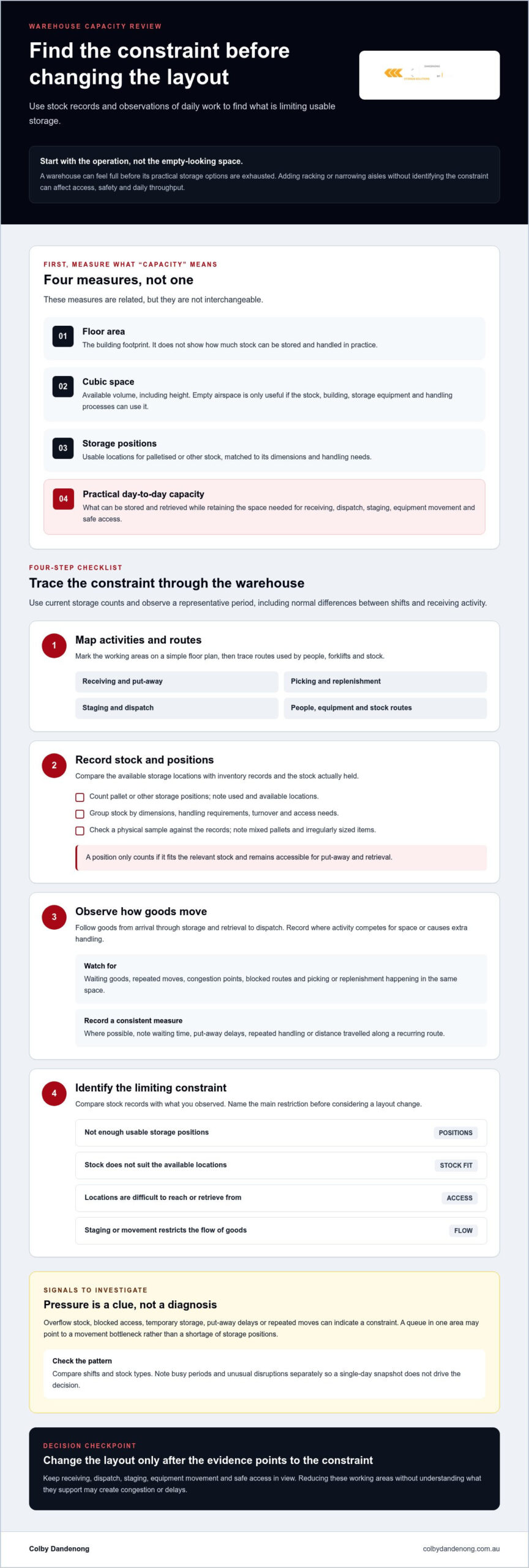
Four measures describe capacity. They’re related, but they aren’t interchangeable.
| Measure | What it tells you |
|---|---|
| Floor area | The building footprint |
| Cubic space | Footprint plus usable height |
| Pallet positions | Locations available for palletised stock |
| Practical capacity | What you can store and retrieve while operating normally |
Empty height above your racking only counts if the stock, equipment, building and handling methods can use it. Services, clearances and access routes all limit what’s usable.
Signs your capacity is under pressure
- Overflow stock, or regular use of temporary storage areas
- Blocked access to locations
- Put-away or replenishment delays
- Staff repeatedly moving other stock to reach or place items
These are indicators, not proof. A queue in one area can be a movement bottleneck rather than a shortage of positions.
Four steps to find the constraint
- Map activities. Mark receiving, put-away, picking, replenishment, staging and dispatch on a simple floor plan, with routes for people, forklifts and stock.
- Record stock and positions. Count current storage positions and compare them with inventory records, including item dimensions, handling needs and turnover. Check a physical sample against the records, because mismatches distort your capacity estimate.
- Observe movement. Follow goods from arrival to dispatch over a period that reflects normal variation. Record where they wait, get moved twice, or compete with people and equipment for space. A one-day snapshot can miss shift and seasonal differences.
- Name the limiting constraint. Is it storage positions, stock fit, access, staging space, or movement through one area?
Match the fix to the constraint
| If you find… | Start with… | Then consider… |
|---|---|---|
| Slow movers in easy-access spots, fast lines far from packing | Re-slotting stock | Separate pick and reserve zones |
| Too few suitable storage positions | Reconfiguring racking or shelving | Adding height with a mezzanine |
| Congestion on routes or in staging | Changing routes and staging areas | Conveyors, where movement is the constraint |
For the options themselves, see tips for maximising warehouse space, do you need shelving or pallet racking? and is it time to move warehouses?. Capacity gains depend on your site, so don’t assume them in advance.
Test small changes first
Set a baseline before you change anything. Pick one measure, such as available positions, delays or distance travelled, and keep using it throughout.
Try reversible changes first, like revised slotting or stock locations. Record the result against the baseline. If the constraint remains, move to the next stage with better evidence.
For equipment or structural changes, plan the sequence so receiving, picking and dispatch can continue. Check racking changes against AS 4084:2023 and WorkSafe Victoria guidance.
Take your findings to Colby Dandenong
Bring a floor plan, current position counts, stock dimensions and turnover, and your notes on where goods wait or access breaks down. See our warehouse storage solutions or contact Colby Dandenong to discuss your warehouse.
Frequently Asked Questions
Is there a standard warehouse utilisation percentage to aim for?
No. A target depends on inventory variability, order profiles and how much room the operation needs at peak. A high figure can look efficient but leave too little flexibility. Use one consistent measure over time and assess it alongside access and congestion.
Does capacity include receiving, staging and dispatch areas?
They matter, but they aren’t storage positions. If you shrink them to add storage, goods may queue or block routes. Assess them against actual volumes and timing.
How does seasonal stock affect capacity planning?
Average stock levels can be a poor guide to peak space needs. Compare stock on hand and inbound volumes across seasonal cycles, and note when products arrive relative to orders.
Can a warehouse feel full when there’s unused vertical space?
Yes. Building structure, services, access equipment and stock dimensions can limit what can be stored higher up, and high positions must stay accessible for put-away and retrieval.
Does higher storage density always improve efficiency?
No. More density can mean less direct access, which adds retrieval steps and complicates replenishment. Compare the storage gain with the effect on picking, rotation and handling.