Beam, Level and Bay Load Ratings: What Your Racking Capacity Figures Actually Mean
A capacity figure on a rack sign can look definitive, but it only helps if you know what it describes. For a warehouse manager reviewing existing racking or planning a change, the real question is whether the figure you have matches the rack in front of you and the way you load it.
That’s hard to establish when drawings are incomplete, components have changed, or records show product weights but not the full stored load. A number borrowed from another installation may look relevant without applying to your site. This guide shows how to read the ratings you have, what to gather before relying on them, and when to ask for a project-specific review.
The short version: use the rack’s own design records and load signs. If they don’t clearly match the installed arrangement or the way loads are stored, get the configuration reviewed instead of estimating.
What a load rating actually describes
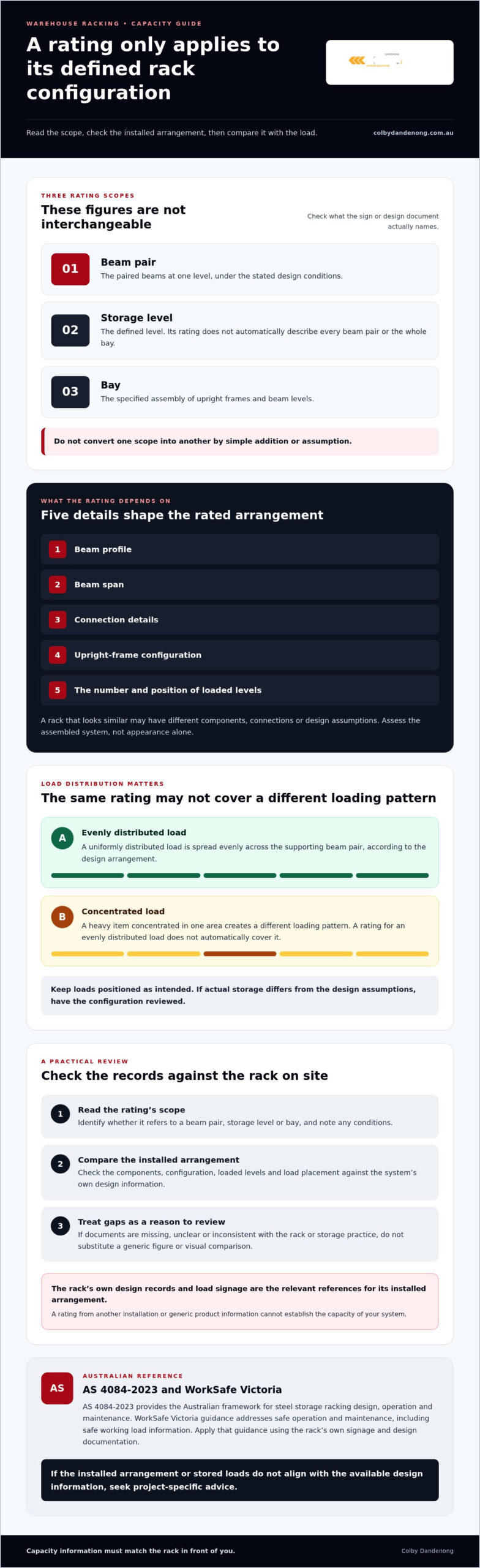
A rating applies to a defined structural condition, not to any rack that looks similar. A sign or design document may state a limit for a beam pair, a storage level or a whole bay. Those are different parts of the system and shouldn’t be swapped for one another.
Start by reading the scope of the figure:
- Which component or assembly does it name?
- What configuration does it apply to?
- Does it carry any conditions or assumptions?
AS 4084-2023 is the Australian standard for steel storage racking. It’s published in two parts: AS 4084.1:2023 covers design, and AS 4084.2:2023 covers operation and maintenance. The standard sets the framework, but the capacity of your installation still comes from its own design.
Beam pair, level and bay are not interchangeable
- Beam pair: the paired beams at one level and the load they’re designed to carry under stated conditions. It doesn’t describe every beam pair in the rack.
- Level: the loads supported at one storage level, and whether the figure is a total for the level or on another basis.
- Frame: an upright frame within the system, which depends on its components and configuration.
- Bay: a defined arrangement of upright frames and beam levels.
A document might state a limit for a beam pair while the sign on the rack shows a limit for a bay. These answer different questions. If the scope is unclear, don’t convert one figure into another by adding or assuming.
Why a generic figure can mislead
Published figures belong to the products and configuration described by their source. Components that look alike can differ in dimensions, connection details or design assumptions, and separate areas of one warehouse may have been designed differently. An online example or another supplier’s data can explain the terminology, but it can’t give you a rating for your rack. If your records are missing or don’t match what’s on site, don’t fill the gap with a generic number or a visual comparison.
How beams, frames and load distribution affect ratings
A beam-pair rating depends on more than how the beam looks. Beam profile, span and connection details are all part of the rated arrangement, and a change to any of them can mean a published figure no longer describes what’s installed. The frames carry the loads that pass through the beams, so a rating for one component can’t stand in for the design of the assembled rack.
What “uniformly distributed load” means in practice
A uniformly distributed load is spread evenly across the beam pair supporting it. It’s a loading assumption, not permission to place stock wherever it fits. Concentrating heavy items in one area creates a different pattern, and the stated rating doesn’t automatically cover it. WorkSafe Victoria also notes that if a load is supported at only two or three points, the supplier should confirm whether the racking can take it.
Keep loads positioned as the design intends. If your actual storage practice differs from the design assumptions, have the configuration reviewed.
How to review the capacity information for your installed rack
Assess the rack that’s in your warehouse, not a similar layout from a catalogue. Record any gaps as you go.
- Identify the installed configuration. Record upright frames, beams, connection type and beam-level positions. Use project records, drawings and product documentation, and note any differences from what’s on site.
- Establish the loaded pallet weight. Include goods, packaging and the pallet itself. Use product and packaging records or measured weights, not a “typical pallet” estimate.
- Record how loads are stored. Note how pallets sit on the beams, how loads are spread across each level, and whether different products or patterns are used.
- Match the records to the rack. Compare the components and arrangement with the project documents and the rack’s displayed capacity information, and check whether each figure applies to a beam pair, level or bay.
- Check for changes. Have the layout, beam positions, stored loads or loading patterns changed since the design information was prepared? A sign that’s still visible isn’t proof it still applies.
- Resolve uncertainty before relying on a rating. If signage is missing, the records don’t match the rack, or current loads differ from the design assumptions, don’t estimate a safe limit. Arrange a project-specific review.
Keep records by rack area. Different aisles or bays may use different components, so don’t treat the warehouse as one uniform installation.
A capacity review looks at the rack and its loads. A formal pallet racking inspection looks at its condition. They answer different questions and you may need both.
Victorian requirements to keep in view
AS 4084 isn’t legislation. Employers’ obligations in Victoria sit under the Occupational Health and Safety Act 2004 and the Occupational Health and Safety Regulations 2017. WorkSafe Victoria’s guidance says racking should be set up, operated and maintained according to the manufacturer’s instructions and AS 4084.2:2023, and that employees should be given safe working load information, such as signs showing the unit load limit and the total limit for each beam level and bay.
The same guidance says safe working loads should never be exceeded, and that changing the racking configuration alters them, so changes should be made only by the supplier or a suitably competent person. Replacement parts should be compatible parts from the equipment manufacturer. Check WorkSafe’s current guidance alongside the standard and your system’s documentation.
For common overloading and signage errors, see our guide to pallet racking mistakes to avoid. For what the 2023 standard means for existing racking, see is your pallet racking up to the AS 4084:23 standard?
When to ask for a project-specific review
A design review is the right next step when:
- Actual pallet or product loads differ from the records
- The layout, components or beam positions have changed
- Capacity signs are missing, illegible or don’t clearly match the installation
Before you call, gather the rack drawings, load signage, component details and reliable pallet weights, and note any changes since the records were made.
Colby Dandenong designs, supplies and installs Australian-made pallet racking systems for warehouses across Melbourne and Victoria, relating stored loads to the rack configuration instead of a generic rating. Contact the team if your information doesn’t clearly match your installation.
Frequently Asked Questions
Does pallet weight include the pallet and packaging?
Yes. Compare the complete loaded unit (pallet, goods, wrapping, cartons and strapping) with the rack’s load information. A product-only weight doesn’t represent what the rack supports.
Can adding a beam level increase the capacity of an existing bay?
No. A new beam level creates another storage position but doesn’t automatically raise the bay’s rated capacity, and it changes the demands on the frames. Have the revised configuration assessed first.
How can pallet overhang affect a capacity assessment?
Overhang can shift where the load bears on the beams and how it’s distributed. If overhang is part of normal storage, include it in a project-specific assessment, not just the pallet’s total weight.
Does an uneven warehouse floor change racking capacity?
It can affect alignment and how the frames transfer load to the floor. Don’t adjust a capacity figure informally. Record the affected area and have the rack and its support conditions reviewed by a suitably qualified person.
Are capacity labels still valid after the layout changes?
Don’t assume so. Moving beams, adding levels, replacing components or rearranging bays can create a configuration the original rating doesn’t cover. Record the change and have it assessed before relying on the label.
What should I do if loads may exceed the listed rating?
Don’t load the affected position until the discrepancy is resolved. Compare the load information with the signage and design records for the current configuration. If a load may already be stored there, arrange a prompt review and follow your workplace procedures. Refer to current WorkSafe Victoria guidance and AS 4084-2023.