Cold Storage Racking: Layout, Airflow and Finishes
Cold storage racking is part of a cold room’s temperature-control strategy, not just a way to store more pallets. The layout has to work around cooling equipment, doors and drainage, keep air moving around stock, and use finishes that cope with cold and damp conditions.
This guide covers how cold rooms change racking decisions, how to plan layout and product flow, what to ask about finishes, and what to check before you choose a system.
How a cold room changes racking decisions
Cold rooms have fixed features that take up space: evaporator fans, vents, doors, drains and sloped floors. Racking has to fit around them.
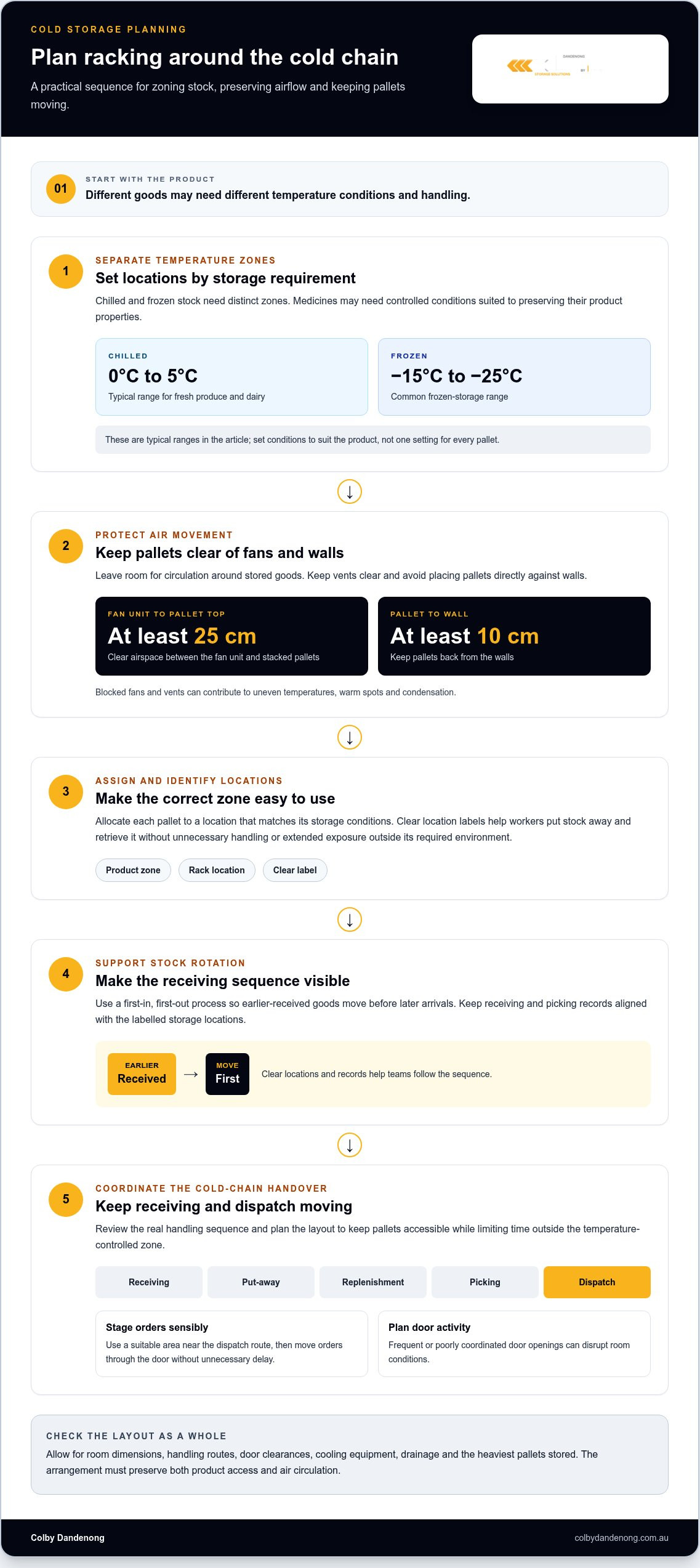
- Airflow: blocked fans or vents can contribute to uneven temperatures, warm spots and condensation. Take clearances around fans, vents and walls from your refrigeration designer or equipment supplier, not from a generic guide.
- Handling: forklift or pallet jack routes need room to enter, turn and exit each aisle, and door approaches need clearance.
- Fixed points: mark doors, columns, cooling units and drains on the plan before you place any rack rows.
Layout and product flow
Start with a scaled floor plan. To record the room properly, follow how to measure a warehouse for pallet racking.
Then match the racking to how stock moves:
- Direct access to every pallet: selective racking suits varied stock and frequent picking.
- First in, first out: pallet live storage is built for FIFO rotation, which suits perishable stock.
- Dense storage of similar products: drive-in uses LIFO, and double-deep stores two pallets deep. Both trade some direct access for density. See drive-in vs double-deep vs push-back.
Also plan the cold chain at the dock. Receiving and dispatch should keep pallets outside their temperature zone for as little time as practical, and goods that need different storage conditions should be in separate, clearly labelled zones.
Finishes for cold and damp conditions
Condensation forms where cold surfaces meet warmer air, so racking in cold rooms faces moisture and, in freezers, ice. The right finish depends on whether the room is chilled or frozen, how humid it is, whether temperatures fluctuate and how it’s cleaned.
Steel with extra corrosion protection, such as galvanised steel, is commonly specified for damp rooms, and stainless steel is often chosen where hygiene is a priority, such as seafood. Colby’s standard racking beams are powder-coated, so raise your room conditions at the start of the project and ask which finish suits them.
A finish doesn’t replace checks. Look for corrosion, impact damage and moisture at upright bases and beam connections. Frost can hide damage, so clear it and assess the rack before it’s loaded again. Repeated build-up in one place may point to a refrigeration or airflow issue to investigate. See how often racking should be inspected and racking protection.
Safety and compliance
For steel storage racking in Australia, use AS 4084:2023 as the reference for design and operation. In Victoria, racking safety also sits under the OHS Act 2004 and OHS Regulations 2017, alongside WorkSafe Victoria guidance. Rack load capacity depends on the actual components, configuration and loads, not on temperature alone, so use system-specific load information.
Fire protection also needs coordinating. There’s no single sprinkler arrangement for every high-bay cold store, so design the racking layout together with the facility’s fire protection design.
Before you choose a system
- Stock and pallets: dimensions, weights, pallet condition and overhang.
- Access vs density: which lines need individual retrieval and which can be stored in batches.
- Rotation: FIFO, LIFO or mixed.
- Fixed features: fans, vents, doors, drains and floor slopes.
- Environment: chilled or frozen, humidity, cleaning method.
- Heaviest pallet: and the room height available.
- Fire protection: who is coordinating it with the layout.
Building the cold room itself? A1 Precision Solutions, Colby’s authorised distributor, builds and maintains cool rooms.
Bring your room dimensions, pallet details and handling process when you contact Colby Dandenong, or see our warehouse storage solutions.
Frequently Asked Questions
Can racking from an ambient warehouse be reused in a cold store?
Possibly, but treat it as a new design. Check the original design records and component compatibility, then have the proposed cold-store use assessed. Don’t assume a relocation is the same as the original installation.
Does frost or ice on racking affect safety?
Yes. It can hide damage and make components harder to inspect. Restrict access to the area until the rack is clear and assessed, and look into why moisture is building up.
How does freezer temperature affect racking load capacity?
Temperature alone doesn’t establish load capacity. The design has to suit the components, configuration, pallet loads and conditions. Use the approved configuration, and have any change to beam levels or loads assessed first.
How do I protect racking against corrosion and condensation?
Choose a finish suited to the room, and keep a simple site record of where moisture appears and which components are affected. Arrange an assessment if you see corrosion, deformation or damaged connections. A coating can’t make damaged structural components serviceable.
How do selective, drive-in and satellite systems compare for cold stores?
Selective gives direct access to each pallet. Drive-in stores similar products densely in lanes using LIFO. Satellite systems, such as the Rapid Runner Satellite System, move pallets into dense lanes. Choose by stock profile and handling.
What aisle width works for a cold store?
There’s no single answer. Size aisles to the forklift or pallet jack, keep door and turning clearances, and check them against room dimensions and airflow. See forklift compatible racking.