A barrier that protects a rack but blocks a forklift route just moves the problem. Before choosing any barrier, work out where forklifts, pedestrians and racking actually come into conflict on your site.
This guide covers how to assess that and how to match each barrier to its location. For the range of products, see our warehouse safety solutions and pallet racking protection pages. For why protection matters, see why you need pallet racking protection.
Table of Contents
- Observe before you specify
- Map your impact zones
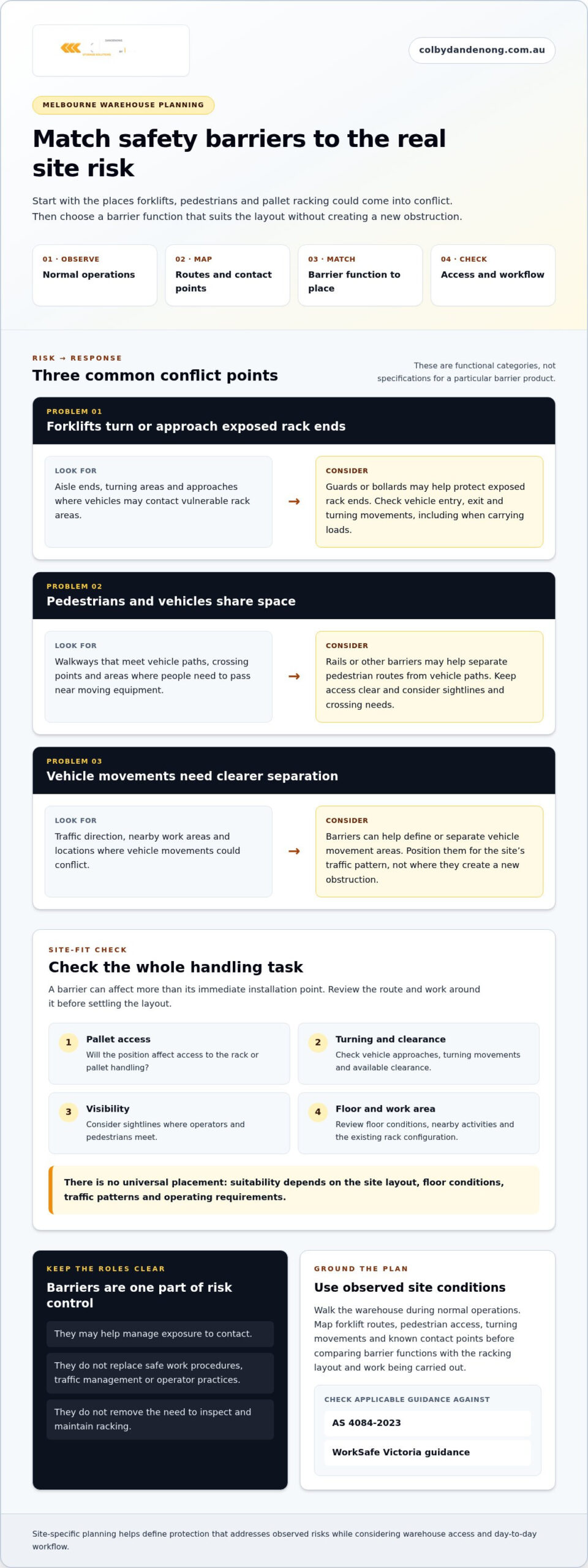
- Match the barrier to the location
- Check the barrier doesn’t create a new problem
- Record the site before you ask for advice
Observe before you specify
Walk the warehouse during normal operations. A layout drawing won’t show how forklifts approach a bay, reverse from a pick face or turn with a load. Watch it happen, and note where people cross vehicle routes. Treat what you observe as fact and what you assume as a question to check.
Map your impact zones
Mark these on your site plan:
- Rack ends and aisle intersections: where vehicles approach, turn or exit aisles.
- Turning and reversing areas: where visibility and clearance change.
- Pedestrian crossings and shared routes: where people and vehicles meet.
- Known contact points: places with a history of damage or near misses.
Don’t assume every aisle, shift or building has the same pattern.
Match the barrier to the location
Each location needs a different barrier function:
- Rack ends and turning points: rack protectors or bollards, positioned for the approach and turn actually used.
- Pedestrian routes: rails or barriers that keep a walkway clear and separate from vehicle paths.
- Vehicle separation: barriers or exclusion zones that define travel areas without becoming a new obstruction.
These are functions, not product specifications. The right choice depends on the hazard and the layout. Barriers support safe work procedures and traffic management but don’t replace them.
Check the barrier doesn’t create a new problem
Test each proposed position against the whole handling task: approach, turning, loading and exit. Check that it keeps sightlines clear at crossings, leaves pallet access practical, and still lets the racking be viewed for inspection. A barrier that fails these checks needs a different position, not a stronger barrier.
For racking requirements, check current AS4084-2023 and WorkSafe Victoria guidance. AS4084-2023 covers steel storage racking, not barrier specifications. Barriers don’t replace regular racking safety inspections.
Record the site before you ask for advice
Bring to the first discussion:
- A site plan showing rack rows, aisle ends and work zones
- Forklift routes, travel direction, and turning and reversing areas
- Pedestrian routes, crossings and restricted-visibility points
- Known contact points and what equipment you use
- Floor conditions and anything that limits access during installation
Contact Colby Dandenong with that record and we can help you plan barriers and rack protection around how your warehouse really works.
Frequently Asked Questions
Where should barriers go around pallet racking?
At the locations your site assessment shows are exposed: rack ends, aisle intersections, turning areas and pedestrian crossings. Position depends on your traffic and layout.
Can barriers be fitted around existing racking?
Yes, if the positions are checked against the rack layout, floor conditions, pallet access and equipment movement. Changes to the racking itself need separate assessment.
Will barriers restrict forklift access?
They can if placed without checking the full handling task. Review approach, turning, loading and sightlines before finalising positions.
Do barriers replace racking inspections?
No. Barriers help manage contact exposure, while inspections assess the condition of the racking structure.